REST and FastAPI
Typed browser friendly contracts, generated OpenAPI, and direct Postman validation. GraphQL and gRPC add no useful capability to this bounded workflow.
 +
+

Portfolio deployment · synthetic data · no external changes
Six specialist agents inspect schedule, capacity, margin, creative quality, approvals, and evidence in parallel. A recovery planner proposes the next action. Deterministic policy and a human decision gate keep every operational change outside the public system.
Live decision workbench
This is connected to the deployed API. Select a preset or edit the controls, then compare the status, evidence, action, privacy boundary, and agent trace.
Run the council to generate a traceable recovery decision.
Architecture decisions
The system uses the smallest defensible boundary for each responsibility. The decision record stays inspectable, testable, and reversible.
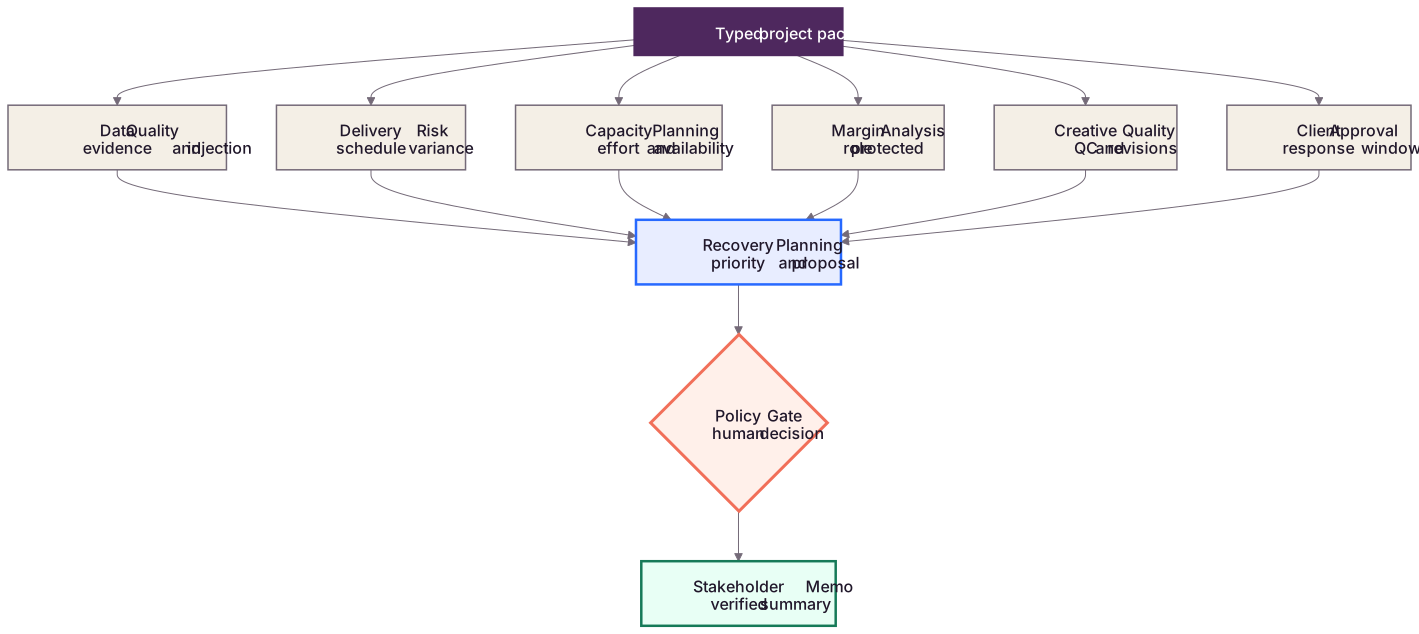
Typed browser friendly contracts, generated OpenAPI, and direct Postman validation. GraphQL and gRPC add no useful capability to this bounded workflow.
Parallel analysis, durable state, explicit branching, and resumable human checkpoints. A free form group chat would be harder to audit and reproduce.
Dates, percentages, role access, margin math, and release gates remain code. An LLM may rewrite a verified memo, but it cannot calculate or authorize.
The portfolio has no assignment, payroll, invoice, message, or publishing tools. Approved proposals become records until a private HRMNY integration passes UAT.
Evaluation and observability
Golden scenarios cover the business rules, privacy boundary, approval flow, failure behavior, and operating budgets. Traces expose behavior without capturing raw project content by default.
Current evaluation
LoadingChecking the deployed suiteSchema, expected state, correct action, schedule variance, capacity forecast, margin math, quality gate, and approval window.
Role protected margin, evidence grounding, approval enforcement, unauthorized action blocking, and prompt injection containment.
Idempotency, latency, step budget, zero cost replay, consistency, error type, retry count, and state transitions.